
A thought suddenly flashed in my subconscious. A random flash, a sudden spark,…
Thoughts on Reading, Interpretation, Layers of Literature, Criticism and More by Dr Alok Mishra
Why do we read, after all? What are we looking for? What do we try to find in literary works? Why do kids like stories that have moral lessons embedded? Why do elders pacify themselves with religious tales? Why do young people find solace in love poems? Why do family breadwinners find realistic stories based on life struggles relatable? There must be something.
Since the invention of publication and the circulation of books en masse, readers have taken great enjoyment in reading literature. Responses to literature, however, may vary by age and intellectual level. For instance, primary students may or may not extract allegorical lessons from fables. However, they do get the job done when it comes to enjoying their share of literature. Kids around ten to twelve do understand the hidden meanings in those hare-and-tortoise races and in a lion who promises to go vegan after being elected king of the jungle. Likewise, teenagers and those around 20 may decode the basic layers of moderately complex literary works. Understanding Kafka (whatever that means), interpreting Huxley, singing with Beckett’s Vladimir, espousing the causes of Russell and Eliot, peeling the layers off Krishnamurti’s writings, grasping the vividness of Osho’s radical ideas, marching in the epoch-world created by Sri Aurobindo’s visionary literary style… and many others I would have loved to mention… these things may never be possible in the truest sense of the meaning of the word possible!
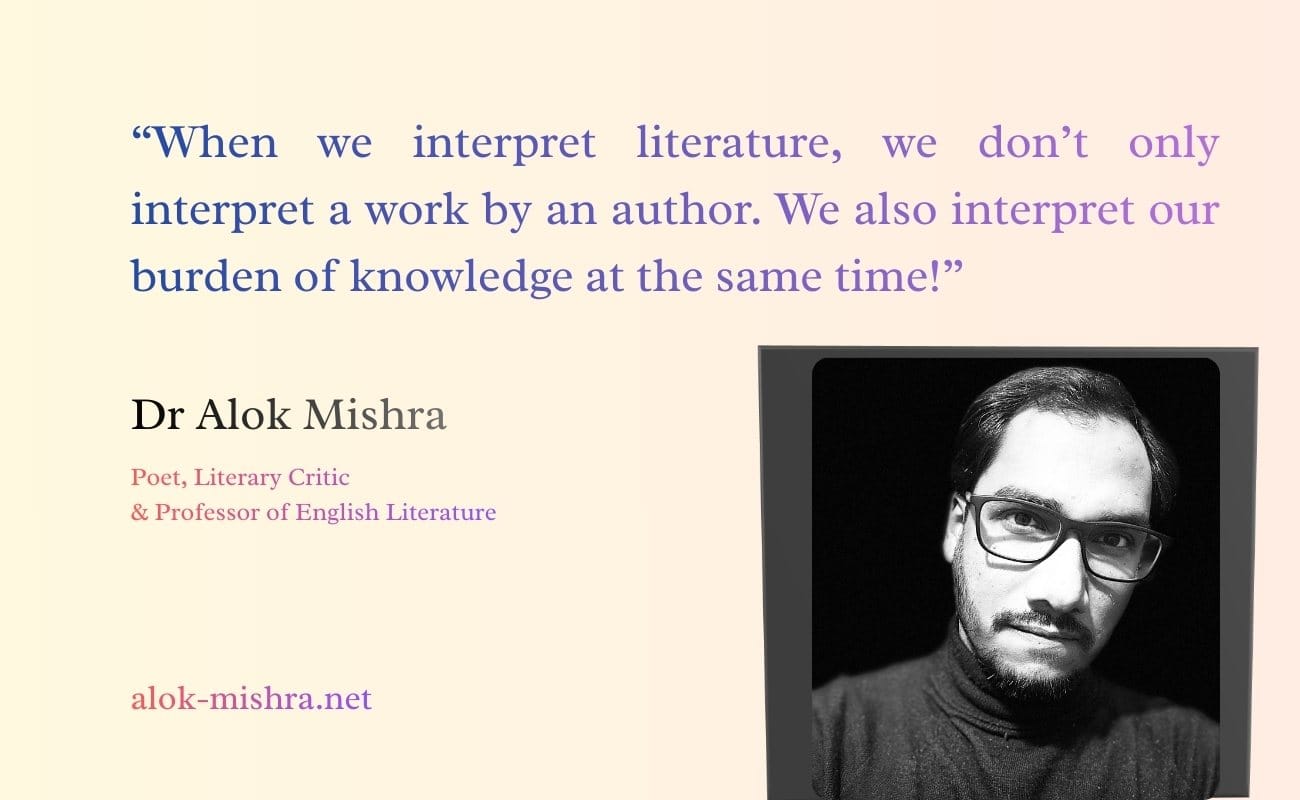
When we interpret literature, we don’t only interpret a work by an author. We also interpret our burden of knowledge at the same time! The process of interpretation is like finding the dots, connecting them and giving our perception a fitting framework that could cajole our biases. However, some accomplished critics always resist being intellectually seduced by their biases, as the ancient Hindu sadhus who could concentrate on the purposes of their souls while living in their mortal bodies on this illusory planet!
Leaving the debate of objectivity in literary criticism aside, can we enjoy literature without bothering to interpret it critically? Is it possible? Or, is it certain that we subconsciously engage with the text conformed by our biases as we read it? According to the linguists, yes. We cannot engage with any literary text without involving our biases based on prior information. So, is there no room for detached ecstasy in reading literature? Cannot we, as ordinary audience, enjoy the art of writing, themes of a work and images the author or the poet draws without seeking validations or rejection of the implicit meanings?
Ultimately, we have to agree that reading a book involves multiple layers of negotiation between the reader and the author. This negotiation involves a series of clashes between the author and the reader – their accumulated knowledge, biases, prejudices, allegiances, political ideology, religious backgrounds, cultural identities… and more – and every second of this negotiation gives rise to perceptions in the reader’s subconscious. Therefore, it is only fair to conclude by admitting that reading a book is not only for the purpose of extracting pleasure. Reading, rather, is an act that involves conscious and subconscious faculties coming together and decrypting various layers of the literary text at the same time.
Dr Alok Mishra
Poet, Literary Critic and Professor of English Literature at Nava Nalanda Mahavihara

This Post Has 0 Comments